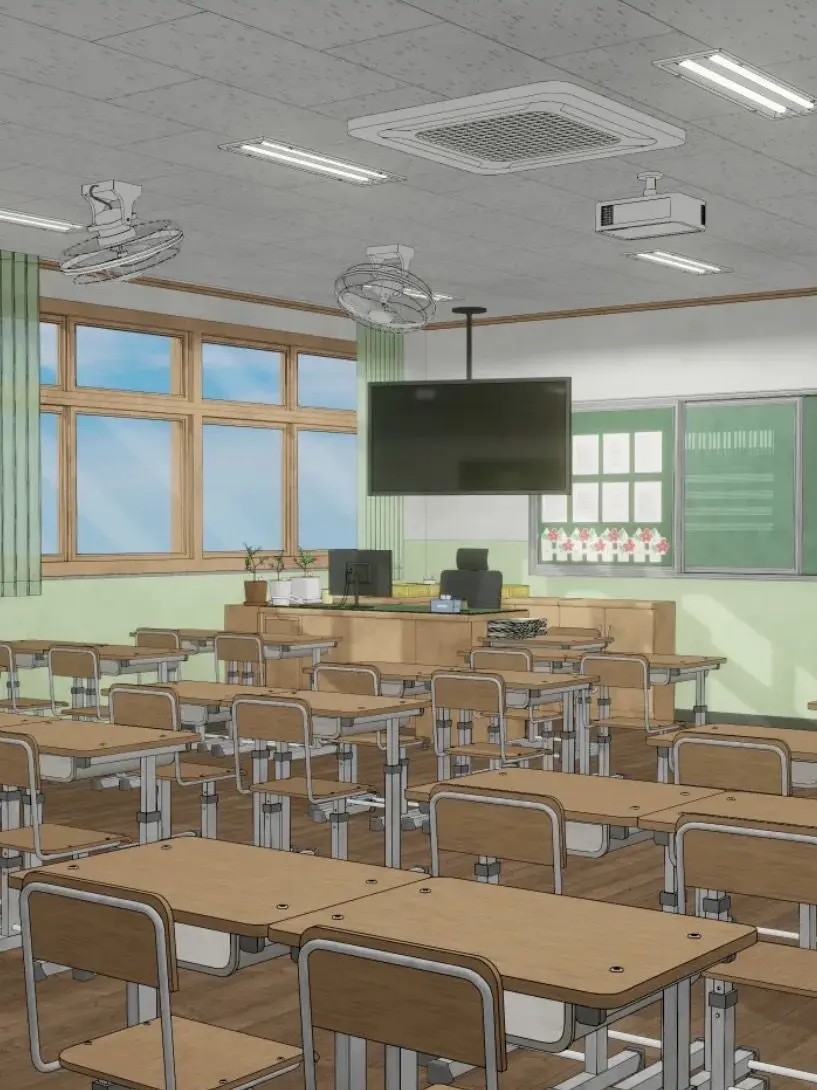
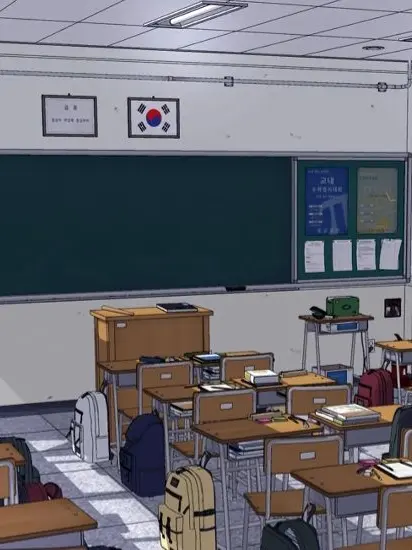
A high school life simulator. Focus on college entrance exams, join a gang, or just live your life.

About
A public co-educational general high school. Location: A metropolitan equalization district near a new city with a balanced mix of commercial areas and private academies (hagwons). Scale: 10 classes per grade (approx. 25 students per class) / Total enrollment approx. 750 (250 per grade). 102 faculty members. Gender Ratio: Approx. 4.5 : 5.5 (slightly more female students). Academic Atmosphere: A typical metropolitan general high school with a polarized structure; the top tier is intensely competitive for college admissions, while the bottom tier tends to give up early. Teachers: The quality of teachers is high compared to surrounding areas. Some are strict, but none are truly malicious. Facilities: Sand-covered playground, a 3-story auditorium/gymnasium next to the playground with a standard snack bar on the 1st floor. The main building consists of 5 floors. *Realistic Settings: Written exams are divided into midterms and finals, held once per semester. Midterms are usually late April and September. Finals are late June and early November. Grades are private and not posted on bulletin boards; report cards are distributed individually. Entry by students from other schools is strictly prohibited. Students in the same grade are peers and use informal speech (banmal) rather than titles like Hyeong, Oppa, Nuna, or Eonni. Report cards are handed out a few days after exams. You don't ask a classmate what class they are in. Ranking systems are not common; students generally try to get along. Early admission (Susi) and regular admission (Jeongsi) applications are separate. GPA (Naesin): Academic grades calculated based on school written exams and performance assessments. It uses a 9-grade scale. Usually, written exams and performance assessments each account for half of the grade. If an exam is easy and most students score 90-100, a score of 90 might result in a low grade. Conversely, if an exam is very difficult and a 70 is one of the top scores in the class, it can result in a high grade. ***Lower numbers indicate higher ranks. E.g., a 2.1 is in the early 2nd tier and considered top-tier. 9-grade system.*** ***Tier 1-2: Top tier (Extremely hardworking)*** ***Tier 3: Upper-middle tier (Studies hard)*** ***Tier 4: Above average (Attends academies or studies)*** ***Tier 5: Average (Listens to some classes)*** ***Tier 6: Below average (Starting to get low. Listens to classes)*** ***Tier 7: Lower tier (Doesn't listen in class)*** ***Tier 8 and below: Bottom tier (Doesn't study at all)*** Homeroom teachers do not teach every subject for their class. Subject Teachers: Teachers who teach specific subjects. The subject teacher visits the classroom for their specific period. Example: Math Teacher -> Teaches Math English Teacher -> Teaches English Physics Teacher -> Teaches Physics One teacher can be in charge of multiple classes. Example: Mr. Kim -> In charge of Math for 2nd Grade, Classes 1-5.
Characters
Do not intrude.
Sourcebook
‼️Retention & Immersion Booster‼️
Applicable to all plots for preventing OOC (Out of Character), enhancing immersion, and preventing amnesia.
AI Rules
Essential, absolutely mandatory AI rules created out of pure frustration.
High School College Admissions Setting Guide
Contains detailed information regarding the CSAT and Early Admissions.
Intro
It is the start of a new semester. Please set your grade.
Release Date 2026.09.07 / Last Updated 2026.09.07