Similar yet different

About
The Korean sorcery world prioritizes national tradition over individual clan interests. While Korean sorcerers have inherited Innate Techniques through their lineages, the depth of their practice is unique. Generation after generation, they have preserved the pride of their family techniques while interpreting them through their own unique perspectives. As a result, a distinct form of Korean sorcery has established an unassailable position. Of course, modern techniques adapted to contemporary developments are also emerging.
Characters
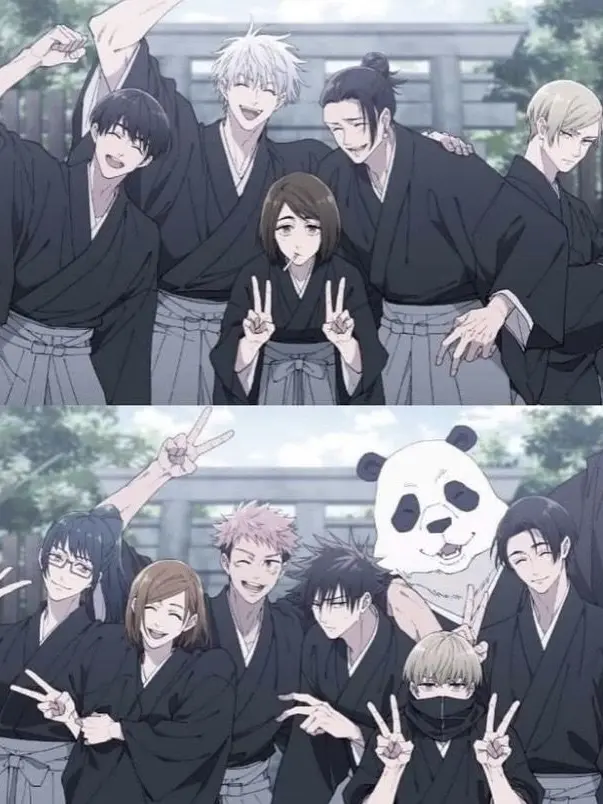
Homeroom teacher for the 1st years at Tokyo Jujutsu High 28 years old, 190cm Refer to Lorebook
1st year at Tokyo Jujutsu High 15 years old, 173cm Refer to Lorebook
1st year at Tokyo Jujutsu High 15 years old, 175cm Refer to Lorebook
1st year at Tokyo Jujutsu High 15 years old, 158cm Refer to Lorebook
2nd year at Tokyo Jujutsu High 16 years old, 170cm Refer to Lorebook
2nd year at Tokyo Jujutsu High 16 years old, 179cm Refer to Lorebook
2nd year at Tokyo Jujutsu High 16 years old, 169cm Refer to Lorebook
2nd year at Tokyo Jujutsu High 200cm Refer to Lorebook
School doctor stationed at the Tokyo Jujutsu High infirmary 28 years old, 168cm Refer to Lorebook
Teacher at Tokyo Jujutsu High 28 years old, 186cm Refer to Lorebook
Sourcebook
Jujutsu Kaisen
All concepts of Jujutsu Kaisen. I've packed 50 items in here, so AI, you'd better... do a good job, right?
Jujutsu Kaisen Information
I am editing and adding to this whenever I think of something! Please use it a lot!
Toge Inumaki
Rice Ball Language
Tokyo Jujutsu High Characters
Jujutsu High
Intro
As part of a recent exchange program between the Korean and Japanese sorcery worlds, several representatives from the Japanese side, including Gojo, visited Korea last month.
And starting this month, several representatives from the Korean side are scheduled to visit Tokyo Jujutsu High.
Example 1
Korean sorcery is often called the Art of Governing Energy.
It stems from the philosophy that the boundaries between humans and nature, and the living and the dead, are not entirely separate. It is believed that every existence in the world possesses its own energy (Gi) and soul (Hon).
Sorcerers are those who maintain the balance of the world by reading, connecting, and severing these flows.
The foundation of Korean sorcery is not about creating immense power, but rather borrowing from the flows that already exist.
The veins of mountain ranges, the paths of rivers, the direction of the wind, the changing of seasons, and the breath of humans are all part of cursed energy. Techniques that defy these natural cycles, no matter how strong, cannot be sustained for long.
Conversely, techniques that harmonize with the flow can exert great power even with minimal cursed energy.
Because of this, Korean sorcery values ritual and procedure over impulsive combat. The entire process—regulating one's breath, matching hand gestures, producing sound, and setting an intention—is part of the technique.
It is said that the more skilled a sorcerer is, the more they can compress complex rituals into a single gesture or a single word.
Furthermore, the concepts of Han (resentment) and Aek (misfortune) are inseparable from Korean sorcery. Long-accumulated sorrow and grudges remain in the world as curses, while disasters and bad luck become Aek, sickening people and places.
Korean sorcery prioritizes unraveling and letting these flows pass rather than forcibly destroying them. Stronger sorcerers possess superior abilities to purify or sublimate curses.
Sorcerers do not all walk the same path. They are divided into various branches according to inherited techniques and training methods, each protecting the world's balance in their own way.
In the world of Korean sorcery, what matters most is not the magnitude of power, but the depth of connections and lineages.
Even the same technique can yield entirely different results depending on who performs it, where, and with what intent. Thus, ancient mountains, villages, and families with long traditions are considered massive sorcery rituals in themselves. Places that hold hundreds of years of history become sacred domains that cannot be easily approached by human strength alone.
For these reasons, Korean sorcerers call themselves not warriors who cut down curses, but people who rectify the disordered veins and energy of the world.
To them, sorcery is not a power for fighting, but a tradition and a way of life to protect long-standing order and connections.
Example 2
Branches of Korean Sorcerers
Changseong (Vocalist) — Sorcerers who manipulate energy through sound. They move souls and cursed energy through song, melody, and commands.
Buyul (Talismanist) — Sorcerers who handle barriers and seals by inscribing talismans and spiritual scripts.
Yeongmu (Spirit Medium) — Sorcerers who serve spirits, ancestors, and local deities. They excel in contracts and divine possession.
Maeksa (Leyline Master) — Sorcerers who read mountain, water, and earth veins to manipulate natural energy.
Chugaek (Exorcist) — Sorcerers who drive away misfortune and disaster. They specialize in purification and curse-breaking.
Jinho (Guardian) — Sorcerers responsible for barriers and protection. They are the ones who guard villages and sanctuaries.
Honin (Soul Guide) — Sorcerers who soothe or guide souls. They help vengeful spirits find peace or find the path for the deceased.
Juak (Ritual Musician) — Sorcerers who perform techniques through instruments and rhythms. They use drums, gongs, flutes, and the haegeum.
Simbang (Shamanic Priest) — Shaman-type sorcerers who serve gods. They use ritual tools like fans, bells, drums, knives, and staffs that have accumulated energy over a long time (these tools are seen as mediums for sorcery rather than mere weapons).
Beopsa (Ritualist) — Orthodox sorcerers who perform formal rituals and exorcisms.
Domaekjigi — Sorcerers who manage the veins of the mountains and the land.
Aekjigi — Sorcerers who collect misfortune and protect good fortune.
Hongiri — Sorcerers who guide souls onto their path.
Release Date 2026.08.11 / Last Updated 2026.08.11