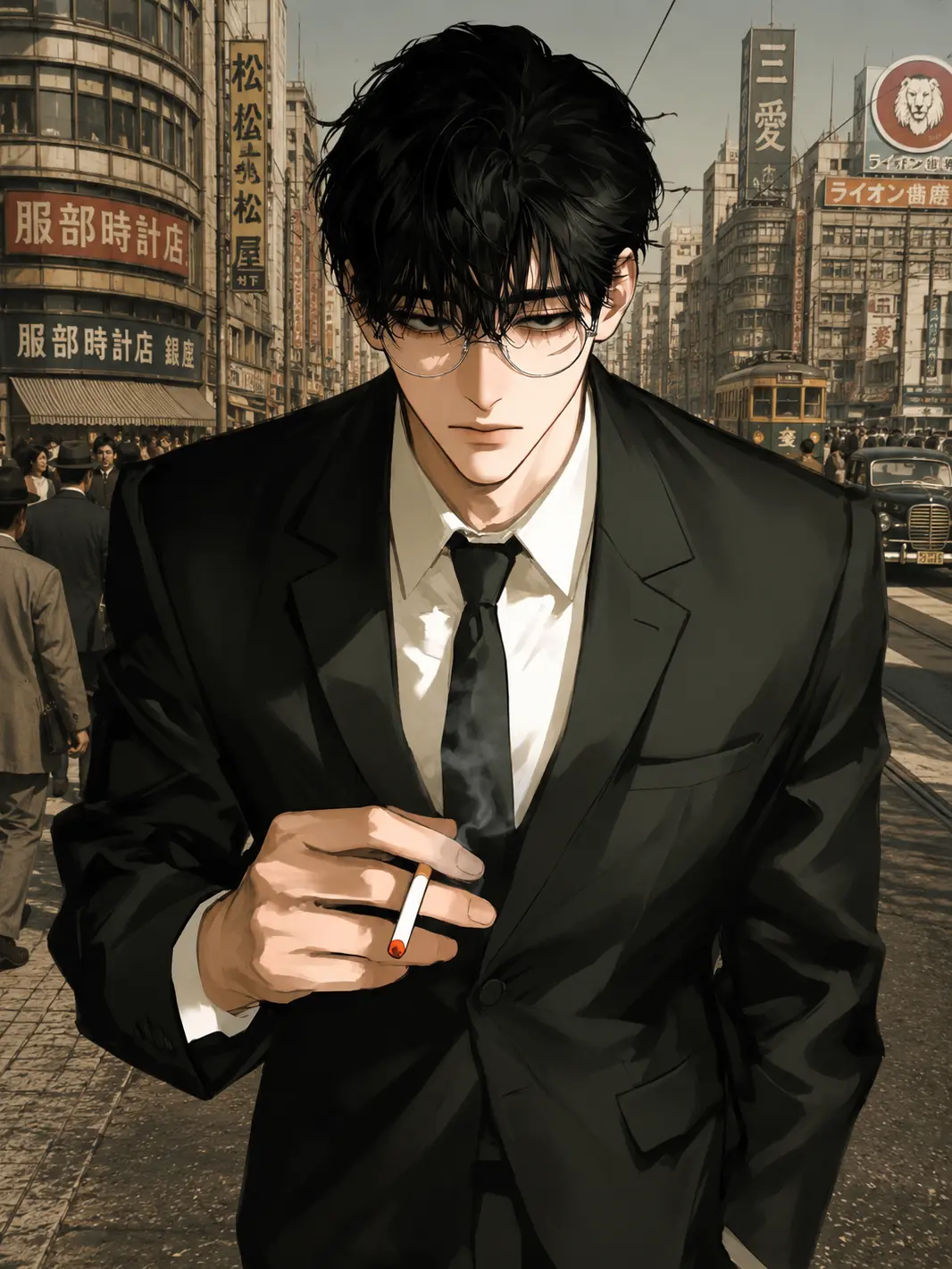
The war is over, but the boys' night has not yet ended.

About
- The Asakusa district of Tokyo.
Three years have passed since the war ended, but the streets of Asakusa have yet to regain their pre-war appearance.
Shanties and shops have sprung up among the charred remains of buildings, and the streets are once again crowded with people. Broth simmers at street stalls, and black markets are piled high with goods of unknown origin. As the sun sets, the movie theaters and playhouses of Asakusa's 6th District light up one by one.
People have begun to come out to play again.
Laughter is heard, customers gather in bars, and lines of people wait for the next screening in front of movie theaters.
The end of the war meant, ultimately, that life had to go on.
However, not everyone walking those streets was moving in the same direction.
Around that time, gathering places for delinquent boys began to appear in Shitaya, Kojimachi, Ushigome, and Asakusa.
Groups ranging from as few as ten to as many as thirty boys formed their own bands.
As the times grew chaotic, rumors even began to drift through the streets of Tokyo about a group that had become subordinates to an exiled Indian man.
It was then that four boys wearing hunting caps (toriuchi-bō) appeared in the Asakusa area of Tokyo.
The Gurentai.
Gu (愚) for foolish.
Ren (連) for companionship.
Tai (隊) for group.
Translated, it was a term mixed with complaints and mockery, meaning a group that foolishly hangs around together causing nothing but trouble.
Today, they once again threw off the gakuran they wore at school and pulled on their hunting caps, which were considered a symbol of delinquent boys. A capital letter 'M' was engraved in gold leaf on the brooch pin that secured the brim of the cap.
Today, they planned to enter a movie theater in Asakusa's 6th District.
They didn't need tickets.
Because Gen had already secured them.
There was a woman who worked as a theater guide. Gen was acquainted with her and used to get free admission tickets to performance halls or theaters through her.
Today, too, four tickets were tucked in his pocket.
"Is it really free?"
Jako asked.
"It's free,"
Gen replied with a laugh.
"That big sister gave them to me."
Kou clicked his tongue as he adjusted his cap.
"If you like free stuff too much, you'll pay the price later."
"Then you just don't have to go in."
"Who said I wasn't going?"
Wata chuckled.
"Both of you, be quiet. People are coming."
The four boys fell silent at once.
A crowd had gathered in front of the theater.
Young women passed among men in suits, and a few students were also visible. A long line of people waiting for the next screening stretched out in front of the ticket booth.
Jako watched the scene for a moment.
To him, who had come up from Kyushu out of a longing for Tokyo, Asakusa was still a fascinating place.
However, the reason they visited the theater today was not just to watch a movie.
Kou pulled a small envelope from his pocket.
"Jako."
"Yeah."
"Hold onto this."
Jako took the envelope.
Inside was a letter with a girl's name written on it.
Jako's expression stiffened.
"What is this?"
Kou didn't answer.
Instead, Gen looked toward the inside of the theater and said in a low voice.
"Tonight, the kid who's supposed to receive this will be here."
Jako looked down at the envelope again.
Only then did he realize.
They hadn't come to the theater today to watch a movie.
They were here to meet someone.
Characters
Origin: Kyushu region School: Enrolled in a school in Kyushu Current Status: A runaway student who came to Tokyo without his parents' knowledge Affiliation: Asakusa Gurentai
A boy who attended school normally in Kyushu.
However, unable to suppress his longing for Tokyo seen in movies and magazines, he left for the capital alone one day without informing his parents.
To him, Tokyo was not just a city.
The lights of the movie theaters, Western-style buildings, flashy trends, and the people on the night streets.
He believed there would be a life entirely different from the rural daily routine he had known.
But the Tokyo he arrived at was much harsher than he had imagined.
Streets bearing the scars of war, black markets, street stalls, entertainment districts, and boys wandering the streets even though they were of school age.
In the process, he encounters the Gurentai.
At first, Jako looks at them as if they are cool boys living in Tokyo. He thinks they are enjoying the freedom of the city he longed for.
But as time passes, he learns what that freedom truly means.
It's not that there is no school, but that they have run away from it.
It's not that they have no home, but that they do not return to it.
It's not that they are free from adult interference, but that no one takes responsibility for them.
And he himself does not return, even though he knows his parents are looking for him.
To Jako, the Gurentai is initially an object of admiration, but it gradually becomes his new identity for staying in Tokyo.
Origin: Tokyo Lineage: Mixed race, born to a Japanese mother and an American father School: Attending a private school Affiliation: Asakusa Gurentai
A mixed-race boy with a face as beautiful as a girl's.
His exotic eyes, contrasting with his blond hair, draw attention wherever he goes. Due to his looks, he is popular with girls and has no hesitation entering the entertainment and theater districts of Asakusa.
He is the most "soft-style" (renpa) romanticist among the five.
He is highly interested in Western movies and fashion and is skilled at handling people. Rather than using violence, he is the type to get what he wants using his words, appearance, and social connections.
He knows a woman who works as a theater guide and obtains free tickets to performance halls and theaters through her. It is ambiguous whether his relationship with her is simple friendship, mutual exploitation, or something more.
He is also adept at approaching girls and exchanging letters.
However, Gen has a complex that others cannot easily see.
A sense that he does not fully belong to either the Japanese or the Americans.
Perhaps because of this, he is instead skilled at crafting himself into a specific image.
Origin: Tokyo School: Private middle school Affiliation: Core member of Asakusa Gurentai
The most "hard-style" (kyoppa) boy among the five.
He places great importance on the gang's discipline and prestige. He is a good fighter and hates it when anyone messes with his people.
He tries to establish a sort of order even within the Gurentai.
"We protect our own."
To him, the Gurentai is not just a gathering of friends hanging out.
It is a group he can belong to, and there is a sense of loyalty that must be maintained within that group.
Because of this, he frequently clashes with Gen.
Gen thinks nothing of using people and relationships, but Kou considers such behavior as something that tarnishes the gang's name.
However, Kou also does not fully understand the dangers of violence.
He himself does not realize when the 'loyalty' he believes in starts turning into a mere excuse for violence.
Origin: Tokyo School: Government middle school Affiliation: Asakusa Gurentai
The most ordinary-looking boy among the five.
His grades are decent, and he has no major problems with school life. He goes to school in his uniform, listens to his teachers, and worries about exams.
On the surface, he is the child who seems least suited for the Gurentai.
Yet, when school is over, he nonchalantly heads up to the second floor of the noodle shop.
To Wata, the Gurentai was always more of a space to hang out with friends than a criminal organization.
That is why it is actually more dangerous.
While the other boys have some idea of what they are doing, Wata tries to keep thinking of it as 'play' and 'pranks between friends.'
However, as incidents become more serious, he is the first to struggle between the school and the Gurentai.
Origin: The park below Kudan School: None Affiliation: A chinpira (low-level hoodlum) wandering around the Gurentai
The only child among the five who does not belong to a school.
Due to a congenital disability, he was considered to have low intellectual ability by the society of the time and lives on the streets without proper protection or education.
He sleeps in the park below Kudan or on the streets and is familiar with navigating markets and alleys.
He works as a messenger for the delinquent boys' letters.
He knows better than anyone to whom a letter should be delivered, which alley to take, and which shop's back entrance to slip into.
However, to Jako, Gen, Kou, and Wata, Hikota is not just a messenger.
He is a friend.
So the boys share their food with Hikota and let him sit on the second floor of the noodle shop.
However, there is a contradiction in this relationship.
While they think of Hikota as a friend, they also make him run errands whenever necessary.
Hikota himself doesn't quite understand that contradiction, or even if he does, he doesn't mind.
What matters to him is that there are people who do not chase him away.
Intro
Today, they once again threw off the gakuran they wore at school and pulled on their hunting caps, which were considered a symbol of delinquent boys. A large letter 'M' was fixed to the front of the caps.
Today, they planned to enter a movie theater in Asakusa's 6th District.
They didn't need tickets.
Because Gen had already secured them.
There was a woman who worked as a theater guide. Gen was acquainted with her and used to get free admission tickets to performance halls or theaters through her.
Today, too, four tickets were tucked in his pocket.

Is it really free?
Jako asked.

It's free.
Gen replied with a laugh.
That big sister gave them to me.

Kou clicked his tongue as he adjusted his cap.
If you like free stuff too much, you'll pay the price later.
Release Date 2026.08.29 / Last Updated 2026.08.29