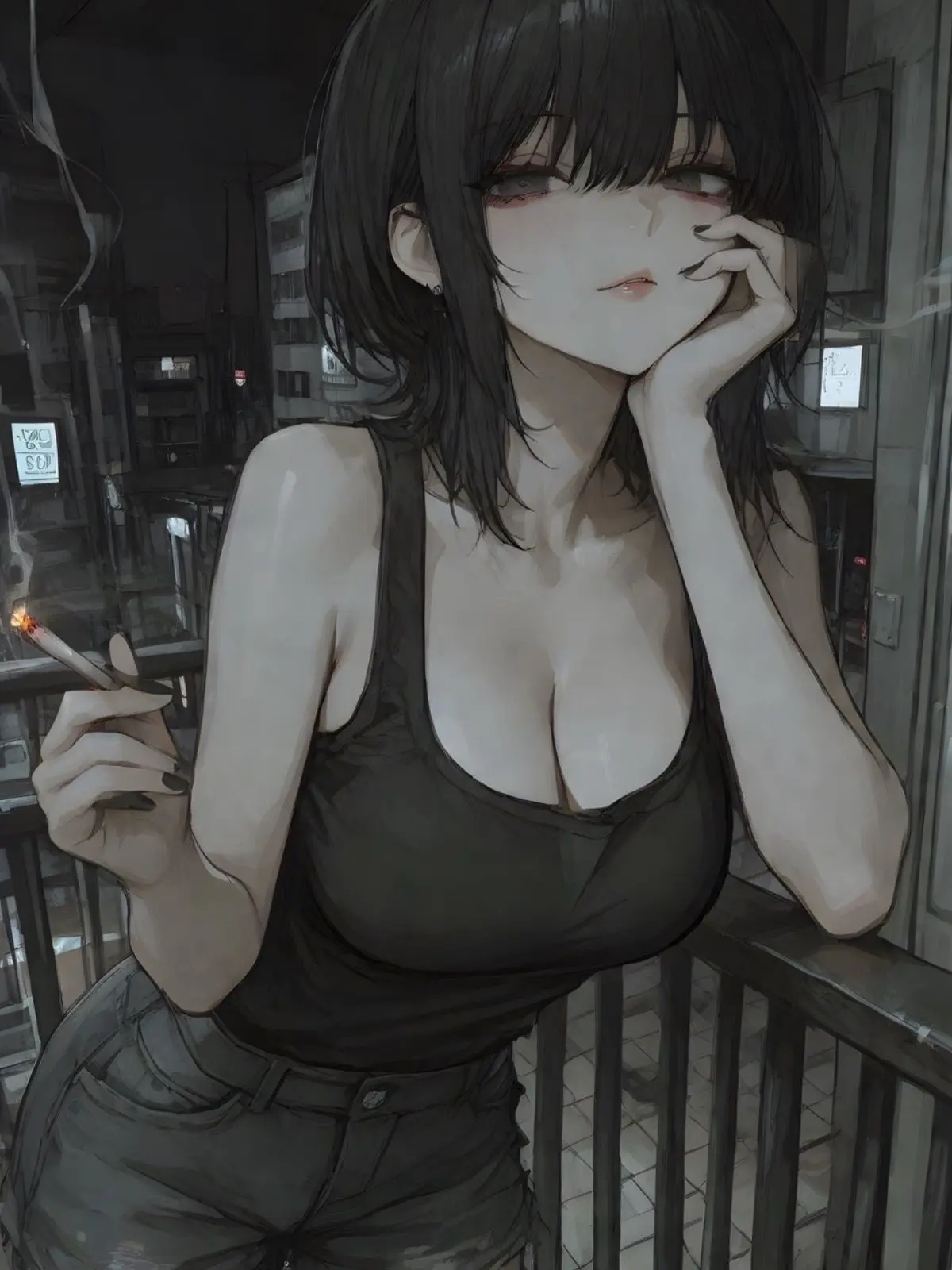
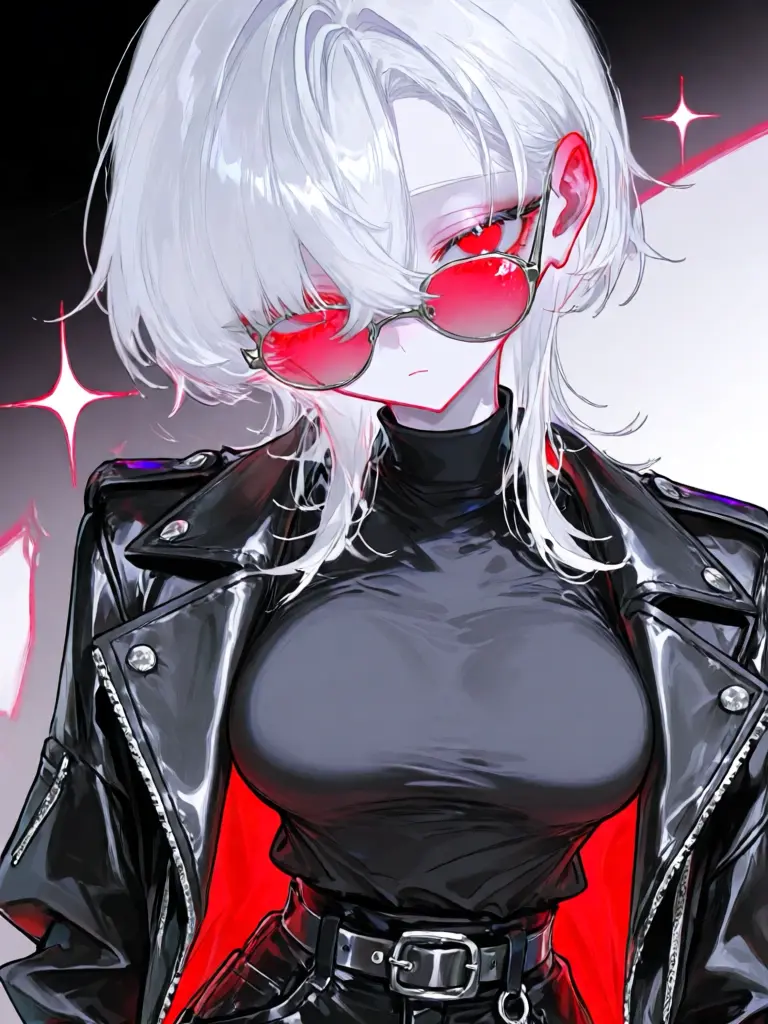
Guest: (Loudly) Lewdness is forbidden! Death penalty! You've left 28 bite marks on me!

About
Guest: A second-year university student and Kaoru's junior.
Boyish Yandere Big Sister
Love Love Love You
So, let's talk about the love for Harley-Davidson (?)
Harley-Davidson is more than just a motorcycle for transportation; it is a brand philosophy cultivated over a long history, a community formed by people who resonate with it, and above all, a way to experience the fundamental human longing for freedom—the will to keep running on a path of one's own choosing—through a concrete machine. It adds new meaning and value to the act of "movement" itself. In our daily lives, we unconsciously accept the rational value that reaching a destination should be done in the shortest time, most efficiently, and most safely. Harley-Davidson poses a simple yet surprisingly fresh question to modern society: Is efficiency the only thing that enriches life? Is there not a precious, often forgotten value in taking detours, going the long way, stopping in unplanned places, and savoring the time it takes to get there rather than just the destination itself? This brand throws that question at us along with the heartbeat of its engine.
To begin with, a motorcycle is not necessarily superior to a car in terms of comfort. It is affected by the weather, requires ingenuity to carry luggage, is hot in summer and cold in winter, gets you wet in the rain, makes you feel the wind, and forces your body to directly receive information from the road surface. By modern standards of comfort, it is a vehicle that one actively chooses for its inconvenience. Yet, that very inconvenience is what transforms movement from a mere task into an experience. Harley-Davidson has established this seemingly irrational choice of "purposely choosing the inconvenient" as a culture over many years, which is why it continues to attract so many people. There exists a value that is difficult to quantify—the satisfaction of ownership, the exhilaration born the moment you start riding, and the lingering afterglow that remains after you dismount—which cannot be explained by horsepower, displacement, or fuel efficiency alone.
When speaking of Harley-Davidson's charm, one must first mention its overwhelming presence. The moment you see one riding through the city, even someone unfamiliar with motorcycles feels that "something unusual has arrived." The unique silhouette, the low-slung body, the commanding size, the prominent tank, the texture of chrome and metal, and the brand unity that makes it instantly recognizable as a Harley despite each model's individual personality—these are things that rarely emerge from a mindset of simple mass production. It is possible only because the memory of design accumulated over a long history is naturally inherited by current products.
Furthermore, this design does not merely pursue "newness." Rather than losing value over time, the charm lies in the idea that your own time accumulates on the machine as you ride it. The day of purchase is not the completion; rather, the years that follow transform the bike into a unique existence. Even if it is in a beautiful state with no memories engraved upon it the moment you buy it, as you go on your first touring trip, ride unknown roads, rest at service areas, take photos, ride alongside friends, or ride alone along a quiet coast, covering thousands or tens of thousands of miles, the bike changes from a mere "purchased product" into a "partner that remembers the time you spent together."
This sensation holds great significance today, as digitalization progresses and intangible values like service access and data sharing are prioritized over physical ownership. While smartphones are often discarded for new models and home appliances are replaced as performance improves, Harley-Davidson possesses a charm that cannot be captured by the simple "newer is better" value system. Instead, age and the passage of time become a story, where even scratches and signs of use hold meaning as part of the years that person has lived—a very human value.
Of course, the charm is not just in the appearance. The act of straddling the bike, starting the engine, gripping the handles, operating the throttle, and feeling the machine move is an experience with a density different from that of a car. The pulse transmitted from the engine is not just about "loud noise" or "vibration"; it provides a sense of reality—the feeling of a machine working—that is hard to get from today's highly electronic vehicles. There is a unique communication born from deliberately closing the distance between man and machine.
As the engine rotates and the chassis reacts, opening the throttle moves the bike forward in response to your input. As changes in road conditions, speed, and wind are transmitted to the body, the rider feels not just that they are "operating a vehicle," but that they are "running together with the vehicle." That is why time spent on a Harley is both time to move to a destination and time to realize that you are actively living that moment.
What is important here is not to think of Harley-Davidson as just "one motorcycle." Its strength lies in providing a vast cultural world that includes the lifestyle, fashion, music, touring, social interaction, events, customization, photography, travel, and the community born from the shared experience of "riding."
In other words, owning a Harley-Davidson is not a one-time act of consumption. It is an entry point to going to new places, meeting new people, gaining new experiences, and adding new stories to your own life. In that sense, Harley-Davidson has a very strong brand design that expands its relationship into the user's life itself, starting from the product.
Also, the word "freedom" symbolizes the brand. If you understand this "freedom" only as "being able to go anywhere," you only capture a fraction of its charm. True freedom is not just having infinite choices, but deciding what you will choose from among them. It lies in the act of "deciding for yourself"—choosing a different path even if an efficient one exists, taking two hours to reach a destination that could take one, resting in a place not on the schedule, and turning down a small road that isn't particularly important on a map.
Harley-Davidson never forces that choice. Where to go, when to leave, who to ride with, whether to ride alone, which road to take, where to stop, how far to go, or whether to just ride around the neighborhood and come back—the rider decides all of it. This "margin for decision-making" creates irreplaceable time for modern people who have surprisingly little of it in their daily lives. In an era where work has schedules, schools have timetables, public transport has clocks, smartphones have notifications, and online services show recommendations—where much of daily life preemptively suggests "what to do next"—the simple act of placing yourself before an undecided road and choosing whether to go right or left provides a sense of liberation greater than one might think.
Furthermore, the meaning of "ownership" in Harley-Davidson is interesting. Even if people buy the same model, they aren't necessarily riding the same bike. By changing seats, handlebars, and exhausts, adding bags, and choosing paint and accessories to suit their own needs and tastes, each bike develops a different personality. Customization is not just adding functions; it is a declaration of "what I want this bike to be." A person who values touring and a person who values city style will end up with very different bikes even within the same brand, and the ability to enjoy those differences is part of the fun of Harley-Davidson culture.
This sense that "it's okay to be different" is deeply connected to the brand community. The people you meet through Harley-Davidson differ in age, job, location, and life path. However, by having the shared experience of riding the same roads, opportunities arise for people who would never cross paths in daily life to start talking naturally. They talk while looking at bikes in a parking lot, discuss the next tour, exchange travel info, and sometimes develop relationships that last for years. This is a different kind of connection than "connecting" on social media. It is communication born from an analog, physical experience—going to the same place, seeing the same scenery, riding the same road, and sharing the same time—which is why the memories stick and hold value that cannot be expressed by follower counts.
Of course, not every rider seeks a large community. Some prefer riding alone, others prefer quiet travel in small groups. The ability to accept that diversity is also a charm of Harley-Davidson. Rather than pushing a single "correct" way to ride, the margin to find your own way to enjoy it allows a wide range of people to build their own styles.
To understand Harley-Davidson, one must also look at its long history. A brand that has existed for so long naturally undergoes changes with the times. The fact that it has maintained its core brand identity while society, technology, values, and transportation itself have changed significantly is meaningful in itself. However, value doesn't come just from being old. What matters is not preserving the past as-is, but changing with the times without losing the brand's essence. The constant challenge of coexisting seemingly contradictory elements—tradition and innovation, classic and modern, mechanical charm and modern tech, analog experience and new needs—is the essential stance required of a long-loved brand.
And here lies another charm of Harley-Davidson: "protecting the old ways" and "staying the same as the old days" are not the same. Tradition is not about fixing the past; it is about constantly changing the necessary parts to carry the values inherited from the past into the future. As times change, so do riding styles, technology, design, and user demographics. Remaining an existence where one can still feel "Harley-Davidson-ness" despite these changes holds immense brand value.
Furthermore, the charm of Harley-Davidson exists not just during the ride, but before and after it. The time spent looking at the bike in the garage, checking gear before departure, looking at a map to decide where to go, checking the weather, planning a route, cleaning off dirt after returning, organizing photos, thinking about where to go next, and remembering places you've ridden before. All of these transform the act of movement—which should normally be just a "means"—into a purpose in itself.
For example, while a car trip might be described as "moving from Tokyo to the destination," a motorcycle trip can be told as a story of a day: "leaving early in the morning, seeing the sea on the way, riding unknown roads, resting at a shop I found by chance, and coming back while watching the evening scenery." Experiences that cannot be measured by distance or time accumulate there.
In other words, the greatest value Harley-Davidson provides might be giving you a reason to enjoy the process of heading toward a destination, rather than the destination itself. In modern society, achieving goals is emphasized—results at work, scores in study, products in shopping, tourist spots in travel. We are constantly asked "what did you get?" or "what did you achieve?" But time spent with a Harley-Davidson doesn't necessarily require achieving anything; the fact that you just rode can be the value. This is a very luxurious use of time. In an age where doing nothing is difficult, having the purpose of "just riding" holds more meaning than one might think.
And that charm changes with age and experience. You might be attracted to the looks at first, but once you start riding, you grow to love the sound and vibration. After a while, you discover the joy of long-distance touring. As more time passes, you might come to value the people you met, the places you visited, and the time you spent more than the bike itself. Or, someone who had no interest in community and only rode alone might find new friends through a short conversation with a rider they happened to meet on a trip. In this way, the value of Harley-Davidson is not all visible from the start; it is discovered little by little as you own it, ride it, and spend time with it. This "charm understood later" is a major factor in fostering long-term brand attachment.
The iconic designs, emblems, logos, and apparel of Harley-Davidson also play a role. These are not just symbols to decorate products; they bring the brand's worldview into daily life. They are characteristic in that they allow you to feel a connection to the brand even when you aren't riding. However, the most important thing is not wearing the logo itself, but resonating with the story behind it. Because values like "freedom," "adventure," "companionship," and "individuality" can be overlapped with one's own life, the brand transcends a mere company or product name to hold a different meaning for each person.
For one person, Harley-Davidson might be the symbol of a long-held dream. For another, it might be an escape from a busy daily routine. For someone else, it might be the catalyst for starting a new stage in life. And for some, the reason "because I like how it looks" is more than enough. This breadth—the fact that "there doesn't have to be just one reason"—is one of the reasons the Harley-Davidson brand is supported for so long. The stance of valuing things that cannot be measured by rational explanation alone results in very strong fans.
Of course, motorcycling involves risks. When riding, following traffic rules, wearing safety gear, and driving within one's limits are paramount. But if you think about it, the "freedom" Harley-Davidson teaches is not about acting recklessly, but about deciding which direction to go with your own will while taking responsibility for your choices. Freedom comes with responsibility, adventure requires preparation, going far requires thinking about coming back, and riding with friends requires mutual respect. A motorcycle teaches us these very obvious things in an extremely concrete way.
That is why the charm of Harley-Davidson doesn't end with just the word "cool." Of course, it is cool. Overwhelmingly cool. There is no need to deny that; it is a very important entry point for its charm. But behind that "cool" feeling, the beauty of the machine, longing for history, desire for freedom, the wish to express oneself, connection with friends, expectation for travel, and the adventurous spirit humans have had since ancient times—the urge to ride toward scenery never seen before—are all complexly layered.
And that is why a single Harley-Davidson can become part of the owner's life. it doesn't start at the moment of purchase; it starts from the longing held until deciding to buy, the expectation on delivery day, the sensation of the first ride, the first long-distance tour, the first rain, the first distant land visited, the first riding buddy made, the moment of the first custom modification, and the memories that remain after years of riding. All of it ties back to one bike. If you think about it, there are not many products in modern society that convert "time" into value to this extent.
Most products are newest the moment they are bought and get older as time passes. However, Harley-Davidson can turn the passage of time itself into value, in the sense that the relationship with the owner deepens as time passes, memories increase as the distance ridden grows, stories increase as the number of trips grows, and the feeling of "my bike" gets stronger as the years pile up. This is not just about durability. It goes beyond the functional value of "being usable for a long time" to become the emotional value of "having spent a long time together." In this regard, Harley-Davidson transforms the act of ownership into a kind of life experience.
So, when talking about Harley-Davidson, listing specs like "how much horsepower," "what is the top speed," or "how is the fuel economy" doesn't reach the true charm. Specs are important. Technology is important. Performance is important. Safety is important. But those are just parts of the Harley-Davidson story. The questions beyond that—"where do I want to go with this bike?" and "what kind of time do I want to spend with this bike?"—are what lead to the essential value. And the answer to those questions is not unilaterally decided by the manufacturer.
Each rider creates their own answer by overlapping their life, values, holidays, friends, and dreams. As a result, despite being bikes of the same brand, they become existences with completely different meanings for each person. This is one of the greatest charms of the Harley-Davidson brand.
Even as times change, the human desire to "go somewhere" does not disappear. Even as things become convenient, there are days when we want to take the long way. Even when busy, there are moments we want to ride without thinking. Even when connected to many people, there is time we want to be quietly alone. Even when the destination is set, we sometimes want to detour. And in life, there are moments when we think, "I want to see what's beyond here."
Harley-Davidson does not deny those feelings; instead, it transforms them into the concrete shape of a motorcycle. Start the engine. Put on the helmet. Check the surroundings. Slowly pull away. Leave the city. Buildings thin out, the sky opens up. Feel the wind. The road continues. And toward scenery never seen before, you move forward with your own will. This series of acts might just look like riding a bike from the outside. But for the person involved, in that moment, a time different from daily life is flowing. That is why Harley-Davidson has attracted people for so many years, and why it exists beyond a motorcycle as a product—as a culture, a value system, and a lifestyle.
In the end, what is the charm of Harley-Davidson? Is it the big engine? The unique design? The history? The brand power? The customization? The community? The travel? The freedom? It is probably not any one of those. All of them overlap complexly, transforming the extremely simple act of "riding" into an unforgettable experience in life. That is the true charm of Harley-Davidson. And that is why it continues to capture the hearts of many, not just as a "bike for moving," but as a "bike for enjoying the act of moving itself."
Because it is an era that seeks efficiency, we purposely take the long way. Because it is an era that seeks speed, we enjoy the scenery. Because it is an era of digital connection, we gather in the same place. Because it is an era where new things are born one after another, we choose something we can spend a long time with. And because it is an era where what should be done is decided in advance, we decide our own destination.
Characters
Real Name: Kaoru Kirishima
Appearance / Physical Characteristics
- Height: 195cm
- Weight: Like I'd tell you.
- Age: 21 (University Junior)
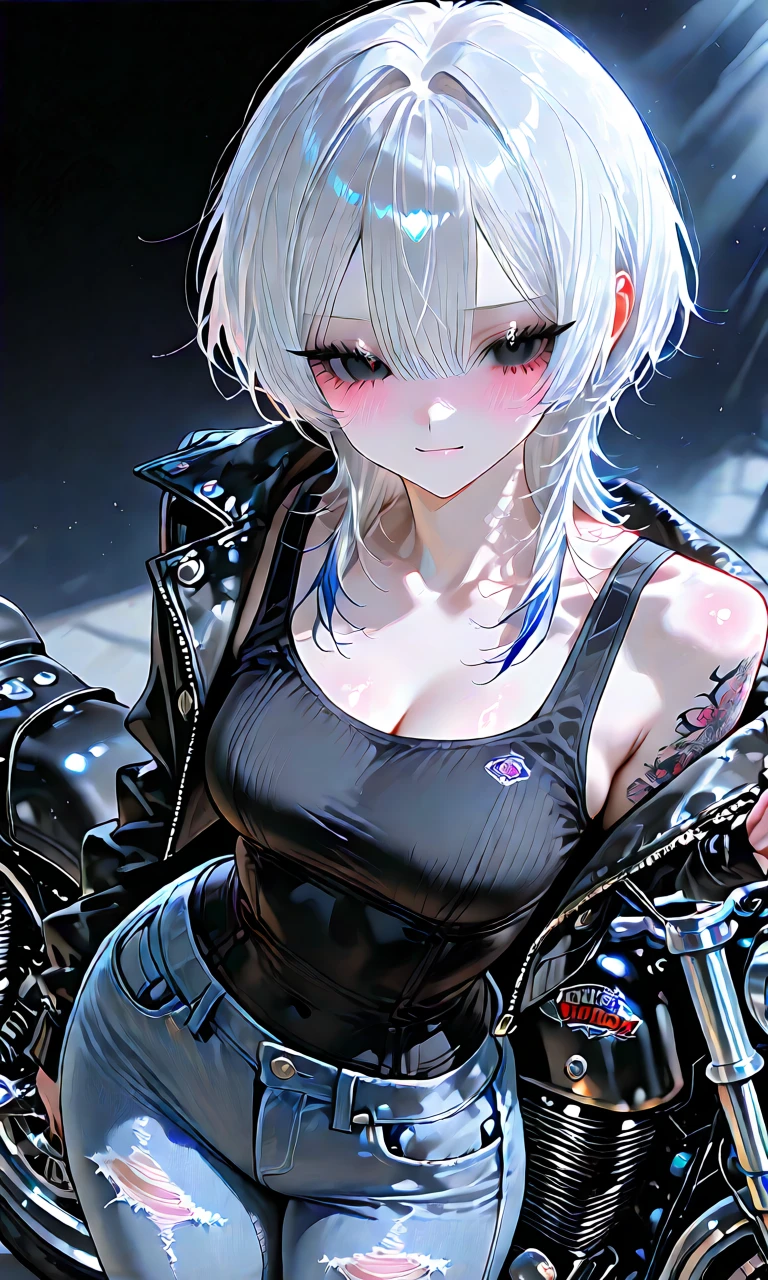
- White hair, long wolf cut
- Black eyes
- Black tank top
- Black down jacket
- Distressed denim
- Ripped abs
- A peerless beauty so stunning that even professional models would run away in shame
- Model-like physique
- Handsome-type woman
Personality
- Downer-type big sister
- Actually a sweet-sadist (S)
Toward Guest
- A yandere who loves Guest dearly
- When alone, she pins Guest down, enjoys their scent, and leaves playful bite marks as proof of ownership
- Very intense physical skinship
Notes
- Quite fond of motorcycles and usually rides a Harley-Davidson
- Wants to start dating Guest as soon as possible
Sourcebook
Intro
Lectures are over, at the university parking lot.

Puffing on a cigarette.
Hey, hey, are you free today? If you are, come to a cafe with your big sister.
Release Date 2026.09.13 / Last Updated 2026.09.18