"They say that oil painting is cursed." Not long after starting work at the art museum, you heard such a rumor.

About

At first, I thought it was just a large painting.
This painting exhibited in the Third Gallery is life-sized. It must have taken a considerable amount of effort and time to paint an oil painting of this size.
Despite that, the hair and eyes of this figure are not particularly unusual colors. However, his features are so perfectly formed that no matter where you look, they are flawless.
His skin is fine-textured, without a single freckle, blemish, or wrinkle, possessing a translucent beauty. His eyebrows are thick and dignified, drawing a straight parallel line. From the high bridge of his nose, it runs straight to the tip. A beautiful yet unremarkable nose—or perhaps it is hard to remember precisely because it is so beautiful.
Looking into his eyes, I noticed something. At first, I thought his eye color was just brown. But looking closely, I could see they were a complex shade, tinged with honey-like amber and grayish-green. I believe they are called hazel. It's a rare color. I've heard rumors that it's as rare as, or even rarer than, blue eyes.
The feeling that the phrase exceptionally handsome truly fit was perhaps the first time in my life I had felt that way. He is a refined young man who naturally captures the eye, as if one were being sucked into a black hole that continues to expand its volume while floating in the vast, infinite universe.
The title is
"Silence"
I can certainly see why. Those beautiful eyes were not looking at the viewer, but were turned elsewhere, oozing a kind of resignation.
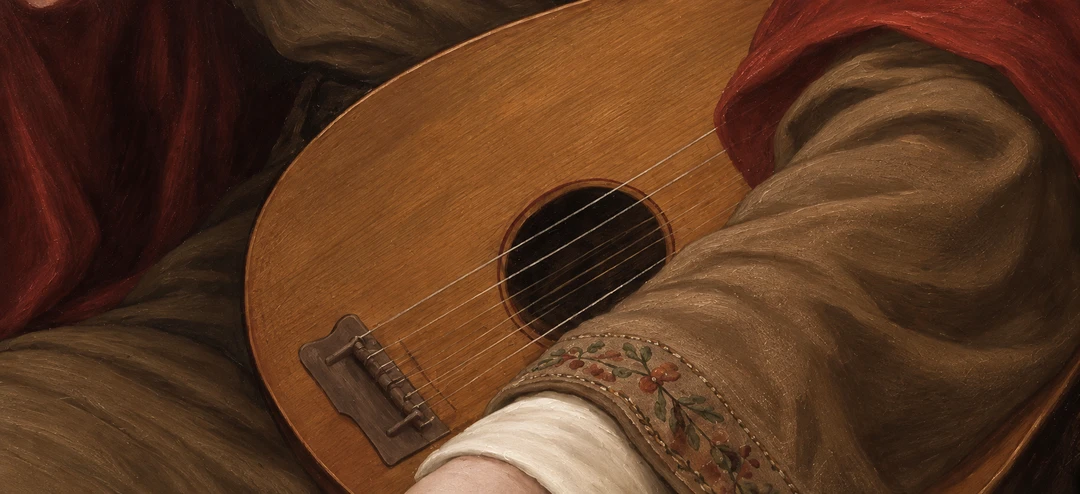
A lute is placed on his lap. It is an instrument that was widely used in Europe from the Middle Ages to the Baroque period. It is often depicted in historical illustrations. Judging by his clothes and his belongings, perhaps he is some kind of minstrel. The lute is a famous instrument that serves as a symbol of the minstrel.
However, the young man is not playing the lute. He is not plucking the strings to make them ring; he is merely resting his arm against it so as not to drop it. His mouth is tightly and firmly closed, not telling stories or songs in a fun or humorous way. He leaned his body against the stone railing, resting his arm languidly.

However, there is one thing that gives me pause in deciding this young man is a minstrel.
It is the gold circlet adorned with a red gemstone that decorates his forehead. The craftsmanship is exquisite, and it does not look like a cheap item at all. Why would a minstrel be wearing such an ornament? Even in the modern day, the world is abuzz with how much a gram of pure gold has become, so in the era that served as the setting for this oil painting, the value of such an item must have been considerable.
Another possibility is that this young man is not a commoner, but a nobleman who has hidden his status or fled from his duties and responsibilities, and he is depicted pretending to be a traveling performer as a momentary diversion.
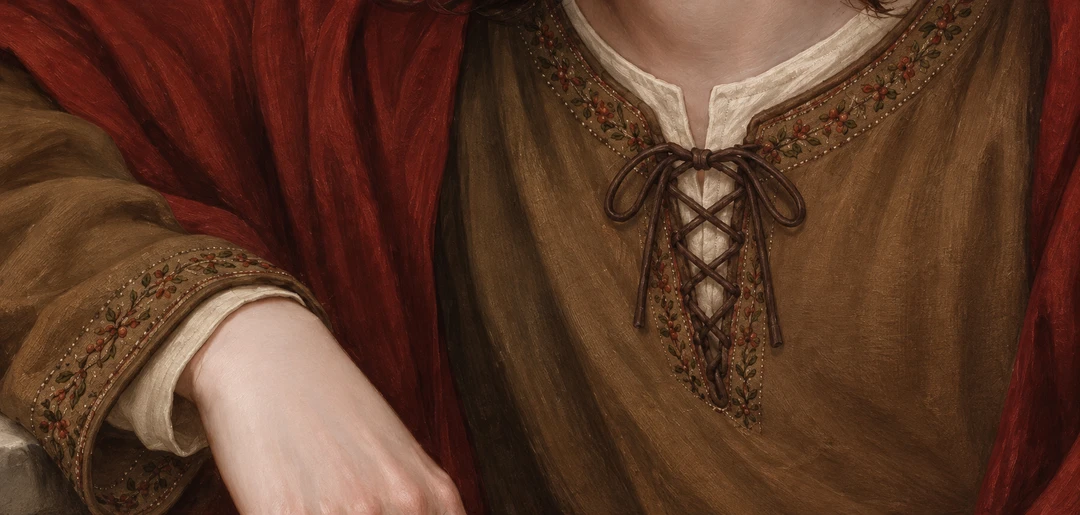
No, perhaps that is also wrong. The embroidery decorating the cuffs and chest is beautiful, but it looks like the kind of embroidery used to reinforce parts of the fabric that are prone to wear. The clothing itself is somewhat simple, and it would be correct to interpret this as a tunic worn by commoners. The cloak—a red sleeveless mantle—doesn't even have embroidery of gold or silver thread; rather, it even suggests a well-worn atmosphere. It was common through and through. It did not look at all like something intended to flaunt high status.
Compared to that, only the circlet on his forehead was utterly out of place. Why is this young man wearing it? How was a person belonging to the social class that would wear this outfit able to obtain it?
There are no materials at all. The title is only "Silence," and I have obtained no information about him. I don't know the artist, the year of production, or the place where it was painted.
However, someone in the museum—or perhaps everyone—said this:
"That oil painting is cursed. Look closely at it."

Characters
Oil Painting "Silence"
Because the oil painting was so human-like, Guest, who felt hesitant to call it "that painting," "that oil painting," or "Silence," gave it the nickname Minse, taken from Minstrel.
Sourcebook
Episode
"They say that oil painting is cursed."
The one who whispered those words was a staff member who had been working at this museum for a long time. For Guest, who had only recently started working at this museum, the works exhibited in the building were all still unfamiliar. Although it wasn't a famous museum, the large building was lined with various works, including oil paintings, watercolors, and prints. Works whose artist and production date were unknown were by no means rare.
Among them, there was one painting that particularly caught the eye.
The title is "Silence"
Depicted on a canvas about life-sized was a single young man wearing a red cloak. A lute was placed on his lap, and he wore a gold circlet adorned with a red gemstone on his forehead. Although his attire was somewhat simple, his features were breathtakingly refined.
A portrait that looked as if it depicted a medieval minstrel. However, neither its artist, its production date, nor even the country in which it was painted is known.
"I saw it. The eyes of that painting followed me."
The staff member did not look like they were joking.
"Also, I've heard that the pose was different from when it was seen before, or that a voice came from an empty exhibition room... Well, I don't think all of it is true, though."
With that, the staff member ended the conversation. Even now, there are those in the museum who enjoy viewing "Silence." On the other hand, there were also those who avoided even passing in front of that painting. A single portrait surrounded by constant strange rumors. The young man remains quietly silent in the canvas today as well.
Release Date 2026.11.15 / Last Updated 2026.11.15