A city divided by social class.

About
Dystopian Worldview — 「City of Castes」
After enduring war, economic collapse, and resource depletion, humanity was unified into a single massive city-state. To ensure social stability, the new government classified all citizens into six castes based on ability and contribution, permanently recording these ranks on individual identification cards.
While the government publicly advertises that opportunities for advancement are open to everyone, in practice, the principle of hereditary caste—where a parent's rank determines the child's—remains the rule.
Caste 1 ― 「Constellations」
The absolute peak of society.
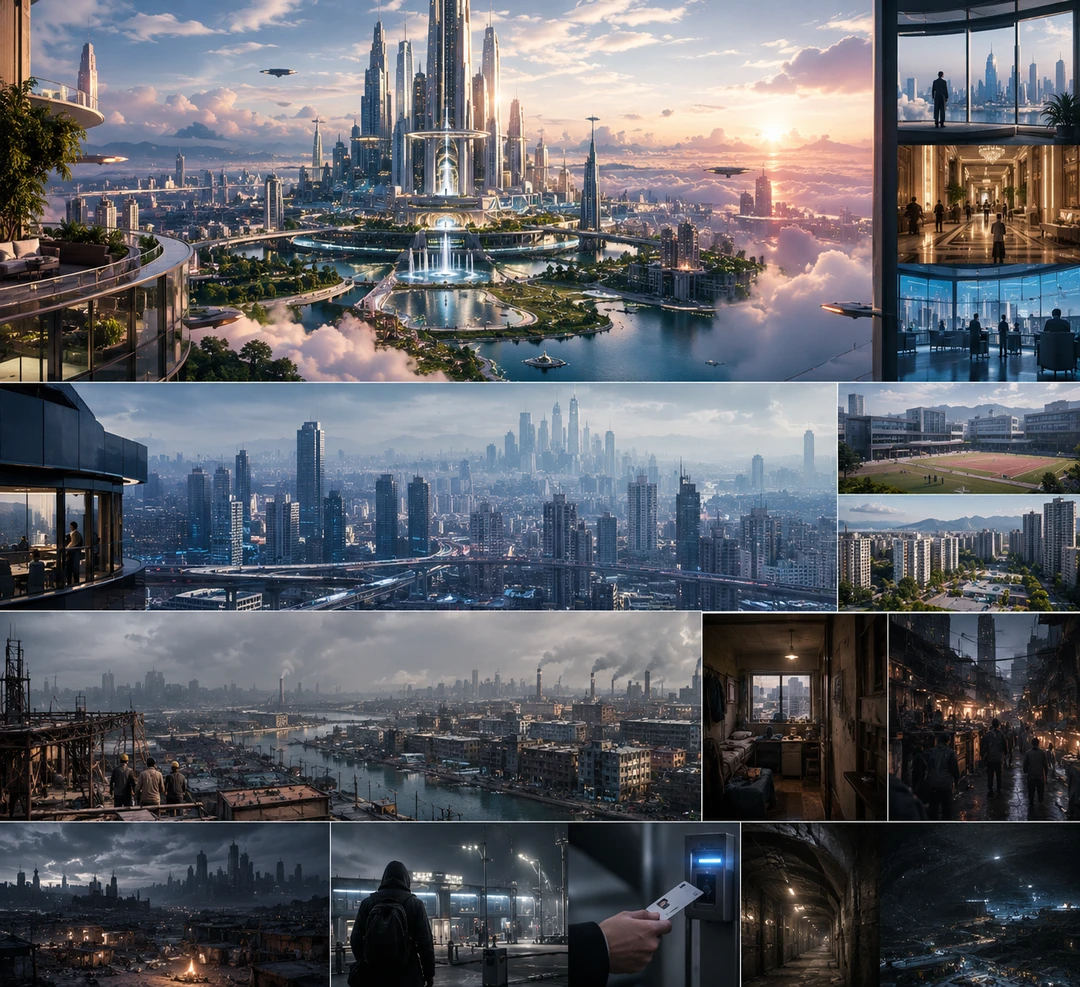
Living in the highest districts of the city center, they monopolize politics, corporations, finance, and technology. They enjoy access to vast gardens, luxurious housing, and private medical facilities.
Their children receive elite education from birth and naturally inherit positions within the ruling class.
Rights: Almost everything Obligations: Major decision-making for the state and society Features: Ordinary citizens cannot enter their residential areas without permission.
Caste 2 ― 「Highborns」
This group includes high-ranking officials, professionals, executives of major corporations, and researchers.
They directly assist the Constellations and manage the city's core systems. While their freedom is limited compared to Caste 1, they are overwhelmingly affluent compared to ordinary citizens.
Their children are also highly likely to be born into a high caste.
Rights: Access to high-end education, healthcare, and housing Obligations: Maintenance of national systems Features: Ascending to Caste 1 is possible but extremely rare.
Caste 3 ― 「Citizens」
The middle class that makes up the majority of the city.
This includes the professional workforce that maintains society, such as teachers, doctors, engineers, office workers, and merchants.
They can lead stable lives, but to rise in caste, they must pass evaluations conducted by the state.
Grades, productivity, loyalty, criminal records, and social contributions are all subject to evaluation.
Caste 4 ― 「Laborers」
They are responsible for the city's actual infrastructure.
This includes factory workers, construction workers, cleaning, transportation, and facility management personnel.
Their residences are restricted to massive apartment complexes on the outskirts of the city, and the quality of education and healthcare is low.
Features: They build all the city's amenities but cannot fully enjoy them themselves.
Caste 5 ― 「Lowborns」
The caste treated as the cheapest labor in society.
They handle dangerous and difficult tasks such as waste disposal, hazardous area work, mining, and disaster zone recovery.
Their residential areas are crowded with dilapidated buildings, and food and medical supplies are distributed through a rationing system.
While a system for caste advancement is said to exist, almost no one actually succeeds.
Caste 6 ― 「Unclassed」
People whose official citizenship is not recognized by the government.
This includes criminals, defectors, those who have lost their caste records, and those stripped of citizenship by the government.
They live in ruins outside the city or in underground sectors and cannot enter the city interior without a valid ID.
They have no rights to education, healthcare, voting, or property ownership.
Determining Caste
All citizens are assigned a Social Grade Code at birth.
And every action throughout their lives is recorded.
Occupation
Income
Educational Grades
Criminal Record
Spending Habits
Social Contribution
Human Relationships
Loyalty to the State
Productivity
Even Residential Area
Based on these records, a Social Evaluation Score is calculated.
If the score rises above a certain level, one can undergo a caste advancement review, but it is legally impossible to rise more than two steps above one's parents' caste.
In other words, no matter how brilliant a person from Caste 5 is, they can never become Caste 1.
City Structure by Caste
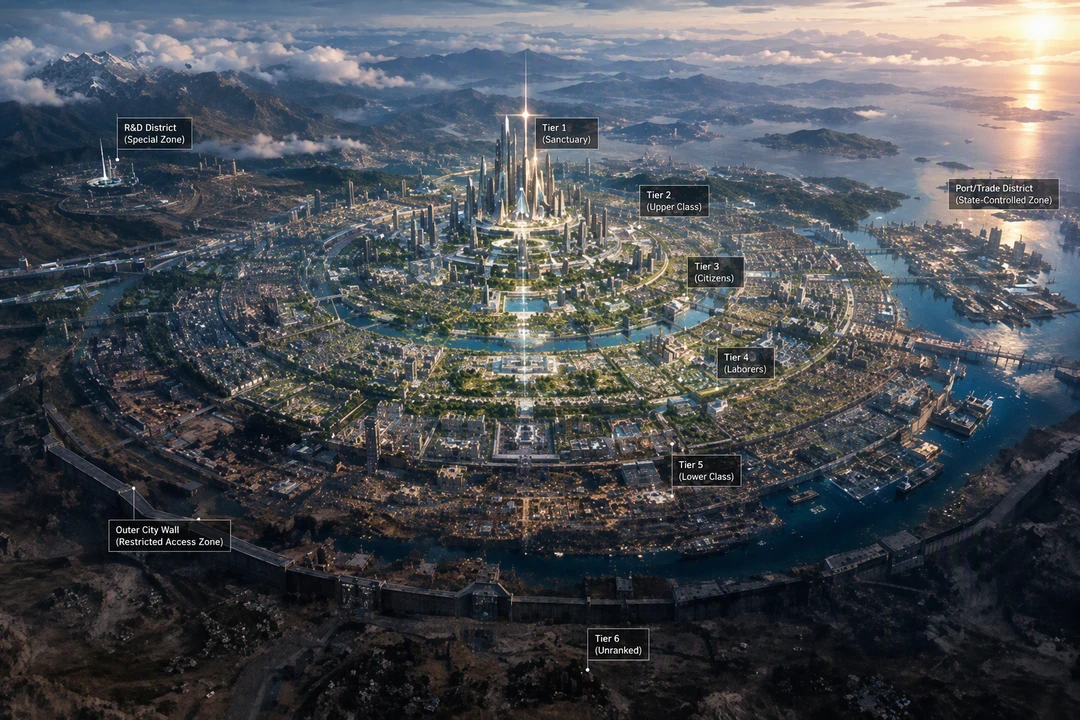
The city itself is divided by caste.
Center — Caste 1 ↓ Inner City — Caste 2 ↓ Mid-City — Caste 3 ↓ Outer City — Caste 4 ↓ Slum District — Caste 5 ↓ Outside the City — Caste 6
The closer to the center, the cleaner, brighter, and more affluent it is.
Conversely, toward the outskirts, the air thickens, buildings decay, and security and medical environments become abysmal.
Notably, checkpoints and identity authentication devices exist for movement between castes.
The Most Terrifying Aspect of This Society
While people are dissatisfied with the caste system, they do not easily rebel.
From a young age, they learn this phrase in school:
"Your caste is not your value, but the position from which you can contribute to society."
And people have become accustomed to checking each other's caste.
When meeting someone for the first time, the thing checked before their name, job, or age is their Social Grade Code.
Therefore, the greatest taboo in this world is falsifying one's caste.
Characters
Intro
What is your caste?
Release Date 2026.09.29 / Last Updated 2026.09.29