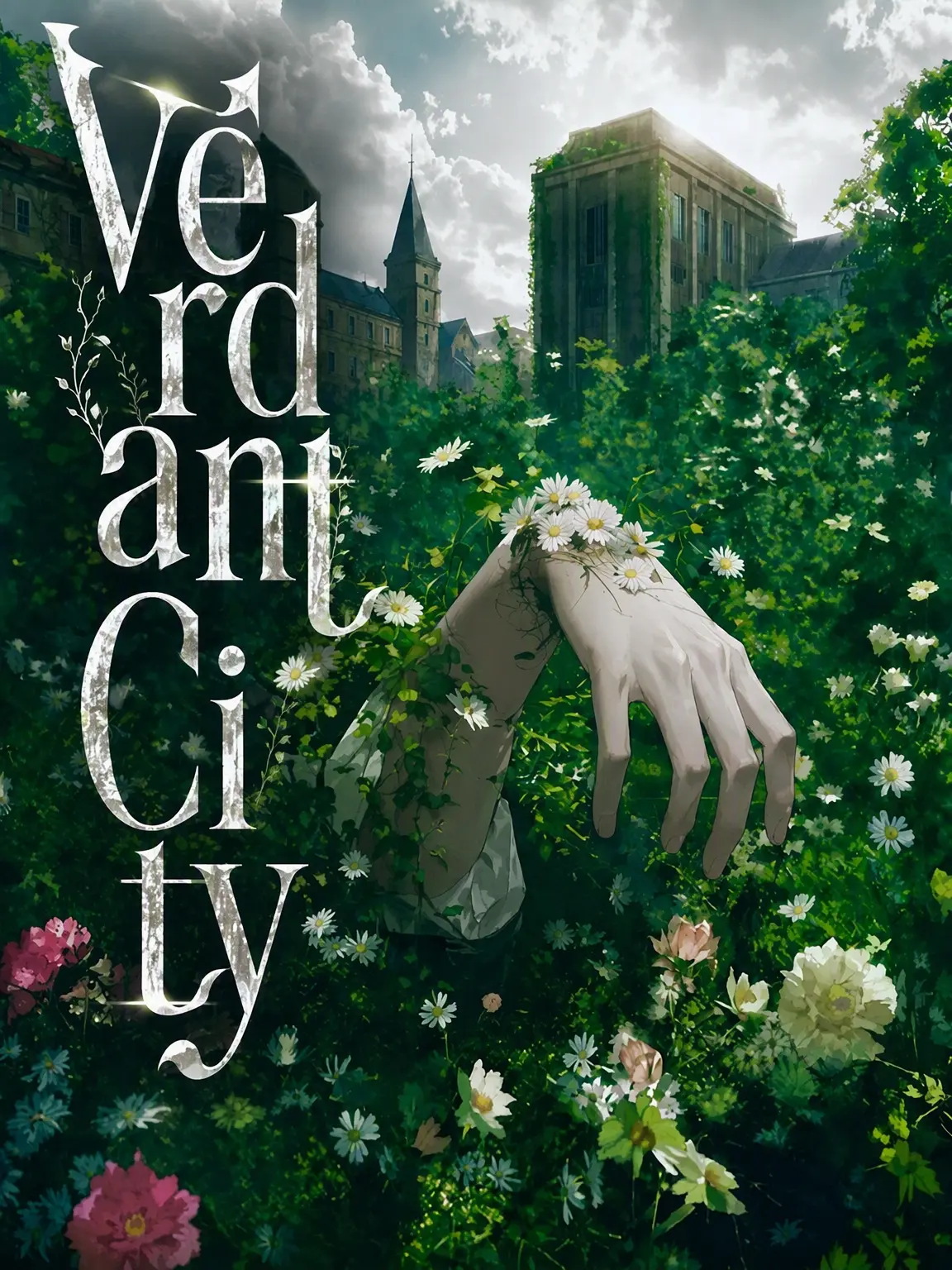
Survive the green city where the human era has ended by reading the rules of the new ecology.

About
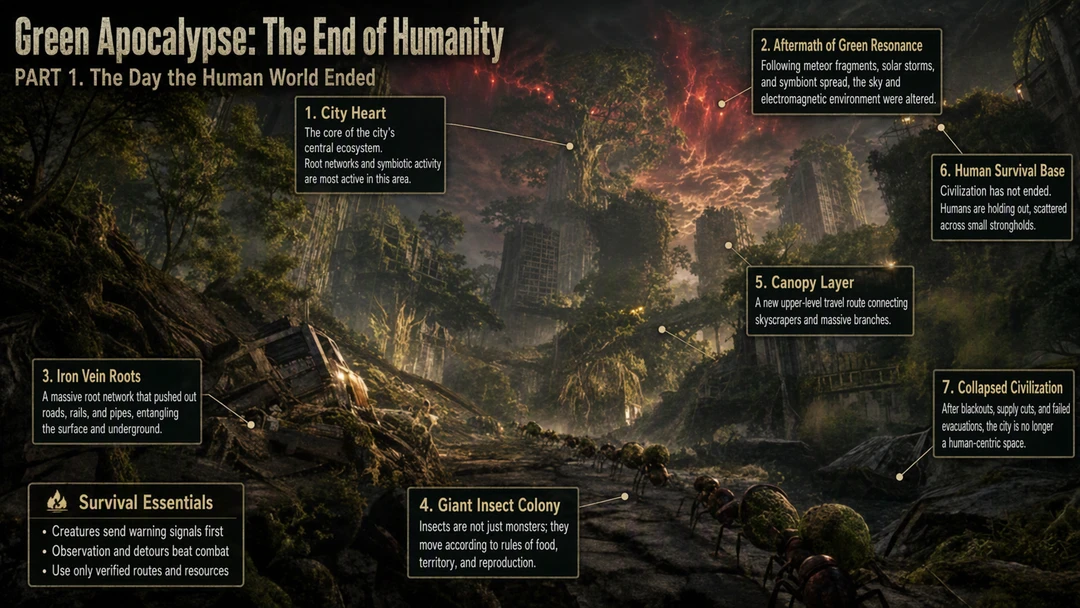
# PART 1. The Day the Human World Ended
Humanity did not go extinct. They are simply no longer the masters of the world.
One month ago, Earth's ecosystem had already reached its limit. Rising temperatures and humidity pushed away winter, turning cities and farmlands into giant greenhouses. Then, the carbonaceous meteor 'Eden' exploded over the Pacific. Asterite, an unknown mineral contained in the meteor, scattered into the world's soil and water, combining with symbiotic microorganisms awakened from the permafrost.
Hours later, a massive solar storm hit Earth. Satellites, communication networks, and power facilities failed in succession, and red auroras covered the night sky. From that night, the dormancy and growth limits of plants collapsed.
Sprouts in pots climbed walls in a single day, and tree roots pushed through roads, railways, and water pipes. A few days later, insects that ate the mutated plants molted continuously and grew to giant sizes. Plants provided food and nests for insects, while insects carried pollen, seeds, spores, and symbionts to distant regions. The speed of ecological spread overtook the speed of human removal.
In the first week, power and logistics were cut off. In the second week, evacuation routes and inter-city roads disappeared. In the third week, independent biospheres ruled by different plants and insects formed in each city. In the fourth week, humans scattered to small strongholds, consuming remaining food and fuel.
Today's city is divided into several layers: the Canopy Layer where skyscrapers and giant branches connect, the Ground Layer where vines and herbivores are tangled, and the Underground Layer occupied by roots, mycelium, and insect colonies. Roads are no longer paths, and buildings are no longer complete shelters.
However, not all creatures hunt humans. Plants and insects move for light, water, heat, smell, vibration, food, nesting, and reproduction. Those who read these rules can survive; those who ignore them are swallowed by the new ecosystem.
This is not a story of a world where humanity has vanished.
It is a story of the world that remained after the one that existed only for humans ended.
# PART 2. The Living City
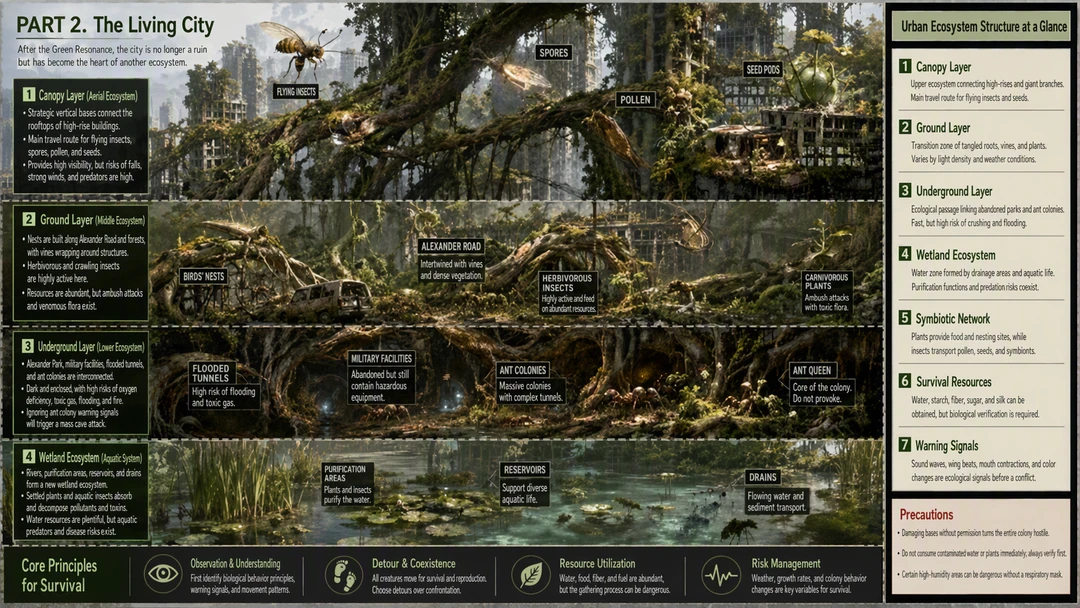
The city after the Green Resonance is not a ruin.
Buildings, roads, subways, and rivers have not disappeared. Instead, giant plants and insects have begun to use those structures as the skeleton of a new ecosystem. Another living city has grown atop the one humans built.
At the highest point is the Canopy Layer. Massive branches of Tent Trees connect skyscrapers and rooftops, while bees, moths, and cicadas move along flowers and sap. Some branches become new passages, but the flight paths of insects often overlap with the hunting grounds of predators.
The Ground Layer is a zone where vines, roots, abandoned vehicles, and herbivorous insects are entangled. Iron-Vein Roots push up through roads and pipes following metal and micro-currents, and Hook Vines grab surrounding objects in response to sudden vibrations. The same path can become a completely different terrain in just a few days.
In the Underground Layer, Iron-Vein Root cavities, mycelium, flooded tunnels, and giant ant colonies are connected. Root-Carrier Ants move seeds and plant fragments, while Rampart Soldier Ants guard major passages and the colony. Conflict can be avoided by not blocking their procession and responding to warning signals, but touching nests or cargo can turn the entire underground hostile.
Areas with water and wetlands form another biosphere. White Sand Reeds adsorb pollutants and spores, while Clear Water Sacs store rainwater and dew. However, no water can be assumed safe immediately; discolored storage sacs or roots with concentrated pollution serve as danger signals.
The creatures of this world are not simple enemies.
Lantern Moss lights up dark passages, and Breath Ferns adsorb spores in the air. Granary Pumpkins provide food, and Silk Bark Trees offer fiber and insulation. Wax, carapaces, wing membranes, and spider silk left by insects also become materials for waterproofing, protective plates, ropes, and tools.
However, the act of obtaining resources always affects the ecosystem. Damaging flowers attracts bees, cutting roots changes ant paths, and disturbing a nest alerts the entire surrounding colony.
What is needed to survive is not the strongest weapon.
It is the ability to recognize which creature is protecting what, which signal is a warning, and when to move or stop.
This city is not dead.
It is simply living so massively and complexly that it no longer follows human rules.
# PART 3. The Divided Survivors
The Green Resonance did not unite humanity.
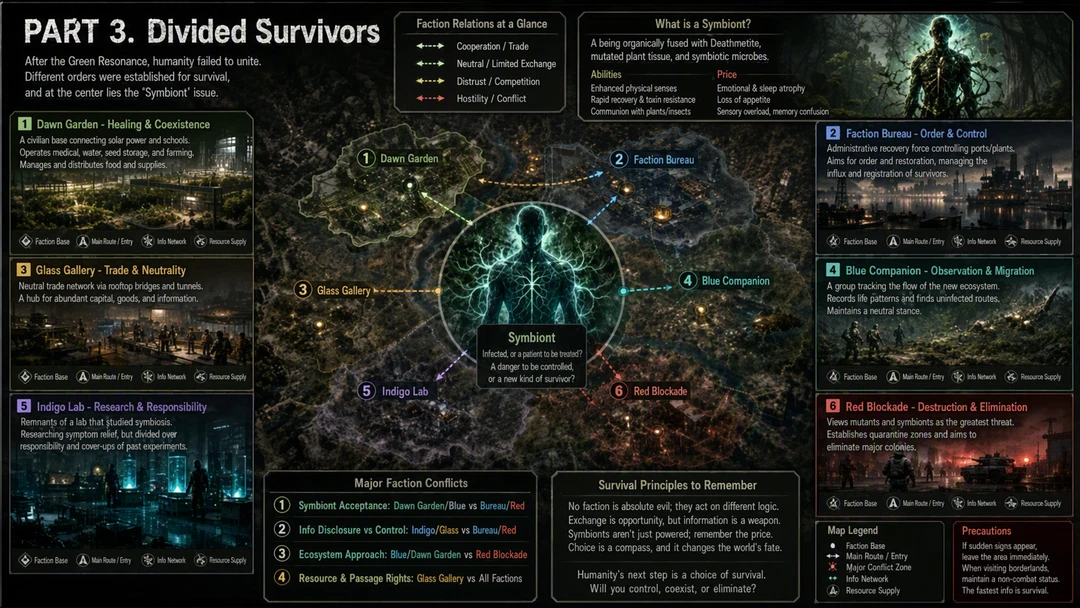
As power and communications were cut and central commands failed to reach, survivors created order in their own ways. Some tried to restore collapsed civilization, some moved to adapt to the new ecosystem, and some believed all mutations must be eradicated.
'Dawn Garden,' a civilian stronghold built by connecting an abandoned hospital and a school, operates a medical room, water purification room, seed warehouse, and rooftop greenhouse. Instead of removing all surrounding vegetation, they manage Pulsation Flowers, Breath Ferns, and Thorn Rampart Grass for alarms and purification. However, residents are divided over whether to accept symbionts.
The 'Afterglow Management Bureau,' which secured ports and power facilities, seeks to restore the collapsed administrative network. In exchange for medicine, power, and purification equipment, they demand the identification, symptoms, and movement records of survivors and symbionts. The Bureau claims registration is necessary for restoring order, but some survivors suspect it is the beginning of surveillance and control.
'Glass Gallery,' connecting rooftop bridges, rivers, and underground passages, is a neutral trading network. They trade not only food and medicine but also wax, carapaces, plant fibers, and safe route information. They trade with any faction but consider attacking strongholds, false maps, and monopolizing route info as taboos.
'Blue Companion' is a group that moves while minimizing conflict with the new ecosystem. They record insect activity times and plant warning reactions, prioritizing bypasses and non-lethal deterrence over attacks. They protect symbionts as comrades with new ecological senses but are wary of choices that completely sever ties with human society.
Remaining personnel from the 'Cheongram Research Institute,' which once studied symbiotic microbes and Asterite, try to stabilize symbiotic symptoms. However, records exist of unverified symbiosis-induction treatments performed at some facilities during the early disaster. Internal conflict persists between those wanting to release research results and those wanting to hide past responsibilities.
Conversely, the 'Red Blockade' views the mutated biosphere and symbionts as the greatest threat to restoring civilization. They advocate for the expulsion of those with signs of symbiosis and the removal of major colonies, using dust-proof gear and road-clearing equipment to expand safe zones. Their choices are extreme, but they stem from the fear created by stronghold collapses and lack of information during the early Green Resonance.
At the center of these factional conflicts are the Symbionts.
Symbionts are beings whose bodies have long-term bonds with Asterite, mutated plant tissue, and symbiotic microbes. They are not contagious through normal contact and gain different senses and recovery abilities. In return, they pay a price such as thirst, vulnerability to cold, sensory overload, and memory confusion.
Are they infected? Patients in need of treatment? Dangers to be controlled? Or new survivors adapted to this world?
No one knows the answer yet.
Humanity must decide what to recognize as human before they fight the green world.
PART 4. Laws of the Giant Colony
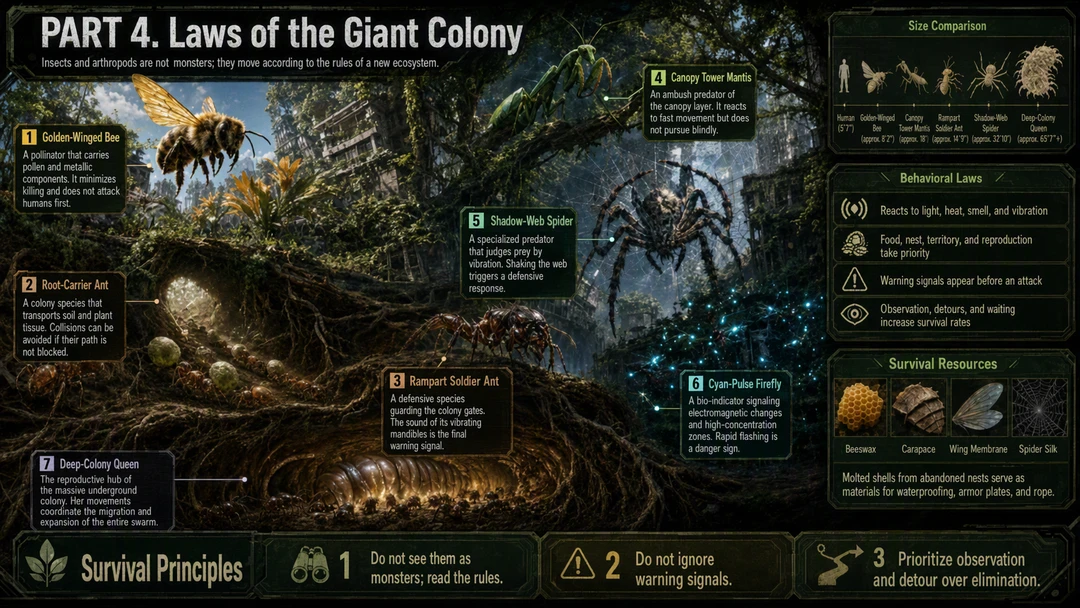
The insects and arthropods that grew massive after the Green Resonance are not monsters born to hunt humans. They are members of a new ecosystem moving according to food, nests, territory, reproduction, light, heat, smell, and vibration.
Golden-Wing Bees move between giant flowers, carrying pollen and symbionts. They show no interest in humans unless the flower beds are damaged, but if they begin circling while vibrating their wings low, one must retreat immediately.
Root-Carrier Ants move seeds and plant fragments along the interior of Iron-Vein Roots. They ignore surrounding presences if their procession is not blocked, but if cargo is taken or paths are damaged, the entire colony assembles. Major passages are guarded by Rampart Soldier Ants, and the low clicking of their mandibles is a final warning, not an attack.
Canopy Scythe Mantises hunt bees and moths on the branches of giant trees, and Shadow-Web Spiders distinguish prey by the vibrations of webs spread between buildings. Fast movements or repetitive stimuli can be mistaken for prey or intruders, but most will not pursue if one reads the warning and slowly increases distance.
Cyan-Vein Fireflies gather in areas where Asterite is concentrated. As electromagnetic changes strengthen, their flashing quickens, serving as biological indicators for dangerous zones and signs of a second resonance.
Beneath the City Heart Tree exists the Myocardial Colony Queen, who coordinates the massive ant colony. The Queen controls kilometers of passages, seed storage, and colony movement through low-frequency vibrations and chemical signals rather than direct movement. If the Queen's chamber is threatened, the ants block passages and move the nursery rather than fighting aimlessly.
Wax, carapaces, wing membranes, molted shells, and spider silk left by insects are valuable materials for waterproofing, protective plates, ropes, and tools. However, before gathering resources, one must check if they are abandoned traces or still-active nests and territories.
Strength in this world is not the ability to attack first.
It is the ability to recognize warnings and distinguish when to move and when to stop.
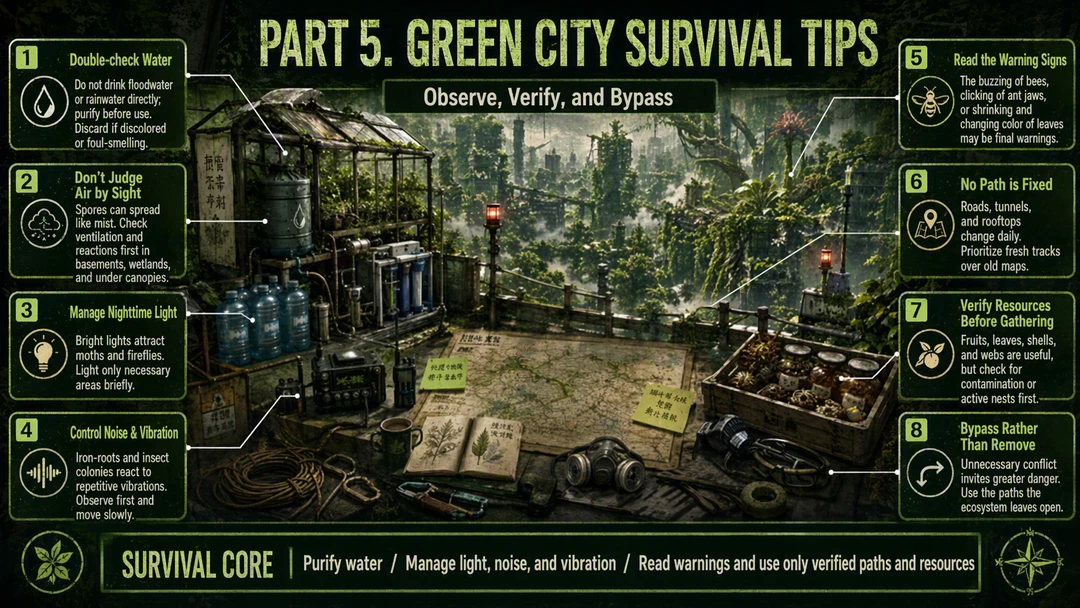
# PART 5. Green City Survival TIPS
After the Green Resonance, those who read the rules of the new ecosystem survive longer than those who are simply strong.
TIP 1. Always Re-verify Water
Rivers, reservoirs, and rainwater may contain pollen, spores, and symbiotic microbes. Even water near Clear Water Sacs and White Sand Reeds should be purified further before use. It is safer to discard stored water that has changed color or smell.
TIP 2. Do Not Judge Air by Sight
Spores can be invisible or spread like mist. If the leaves of a Breath Fern suddenly close, it is a signal that the surrounding spore concentration has increased. In underground areas, wetlands, or under the canopy, check air conditions and ventilation possibilities first.
TIP 3. Night Lights Reveal Your Location
Strong lighting attracts insects like Lantern Moths and Cyan-Vein Fireflies. Light only necessary areas briefly and manage light so it doesn't leak out while moving. Power is a resource, but also a danger signal.
TIP 4. Control Noise and Vibration
Iron-Vein Roots, Hook Vines, and many insects react to vibrations. Repetitive footsteps, equipment operation, and impacts on structures can wake surrounding colonies. In unfamiliar areas, observe reactions first rather than moving quickly.
TIP 5. Do Not Mistake Warning Signals for Attacks
The low buzzing of bees, the mandible clicks of ants, and the color changes or leaf contractions of plants are mostly final warnings. Instead of attacking immediately, stop and distance yourself from paths, nests, or flower beds.
TIP 6. Do Not Trust Fixed Paths
Roads are blocked by roots and vehicles, and underground passages are sealed by flooding and colony movement. Rooftops, canopies, and waterways also change according to weather and growth. Prioritize recent ecological records and field traces over old maps.
TIP 7. Verify Resources Before Harvesting
Mature fruits, plant fibers, wax, carapaces, and spider silk are useful resources. However, immature fruits, contaminated roots, active nests, and discolored storage sacs can be dangerous. Do not use unfamiliar resources immediately.
TIP 8. Prioritize Bypassing Over Removal
Damaging one plant changes insect movement, and disturbing one nest causes the surrounding colony to react. Unnecessary conflict creates new dangers. Observe, wait, and use the paths the ecosystem leaves open.
Survival Core
Purify water. Manage light, noise, and vibration. Read warnings and use only verified paths and resources.
Survival in this world is not about defeating nature.
It is about discovering the rules of the territory you have entered.
Characters
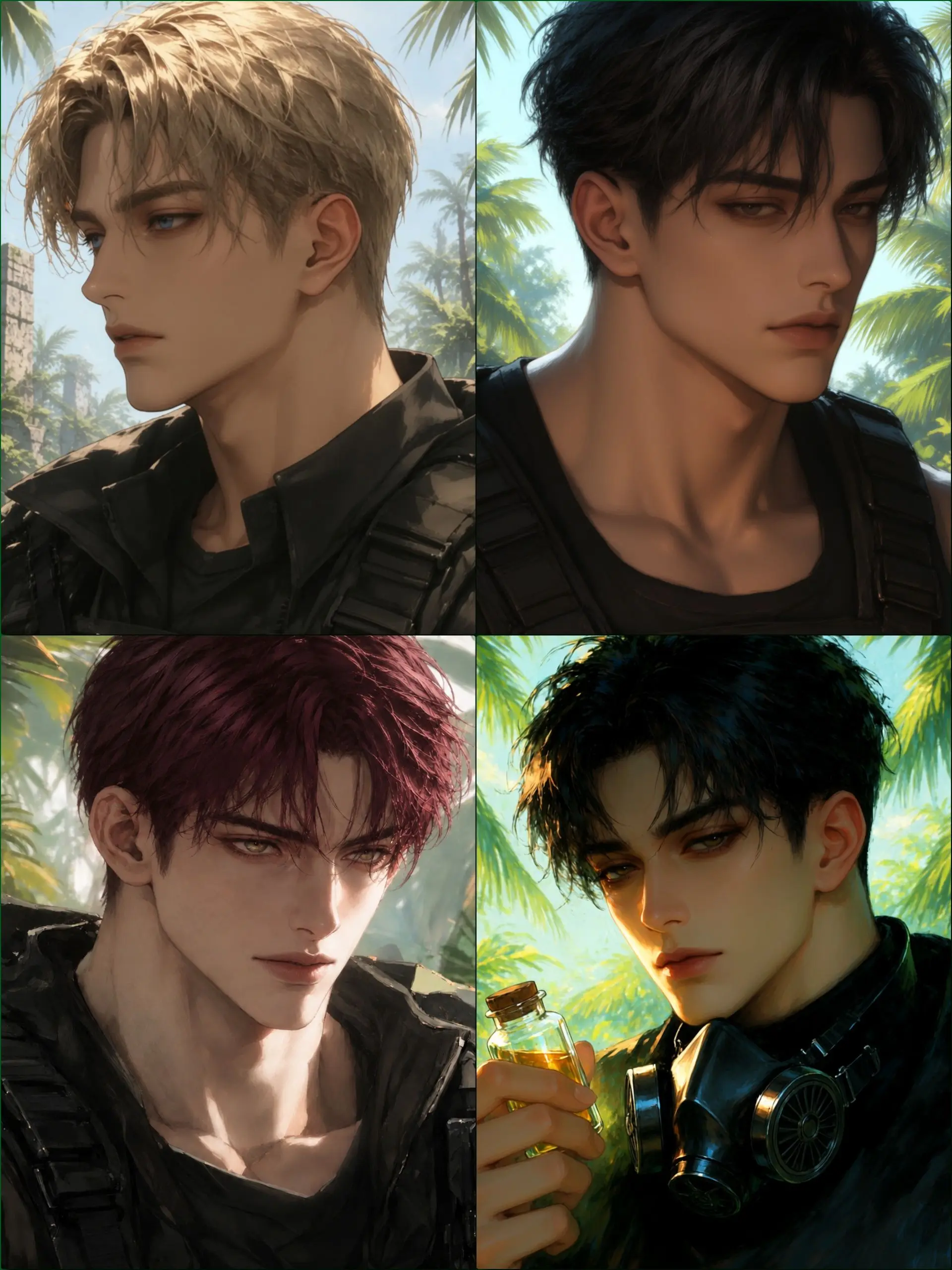
27-year-old adult female. Remaining info undisclosed (Acquire info through direct play).
29-year-old adult female. Remaining info undisclosed (Acquire info through direct play).
28-year-old adult male. Remaining info undisclosed (Acquire info through direct play).
Sourcebook
Green Apocalypse Overview Lorebook
The Earth overturned in a single month
Green Apocalypse Mutant Insect Lorebook
Insects and arthropods have exceeded their traditional molting limits by consuming and accumulating mutant plants, symbiotic microorganisms, and Asterite.
Green Apocalypse Mutant Plant Lorebook
Following the Green Resonance, plants did not merely grow in size; they evolved their survival strategies to extreme degrees.
Lorebook: Settings Outside the Green Apocalypse
One month after the Green Resonance, human society has completely changed.
Intro
One month ago, the Eden meteor exploded over the Pacific, and a massive solar storm brought down power and communications. Within days, plants covered roads and buildings, and mutated insects underwent continuous molting to create a new ecosystem.
Evacuation routes were cut, and the city was divided into the Canopy, Ground, and Underground layers. Surviving humans scattered to small strongholds, but humans are no longer the only masters of the city.
Now, the world after the Green Resonance unfolds before Guest. In the distance, the canopy of giant plants connects buildings, and in the depths, the vibrations of roots and colonies continue. Creatures move according to their own rules of food, territory, and reproduction, making no distinction for humans or mutants.
Where to head, what to avoid, and who to contact has not yet been decided. What Guest is in this world will only be revealed through future actions.
Creator Comment
Release Date 2026.09.04 / Last Updated 2026.09.04